🚀 8 Practical Scenarios Where Generative AI Transforms Engineering Workflows
Generative AI is steadily changing how engineers design, test, and optimize products. Beyond automating tasks, it’s redefining how ideas move from concept to creation, improving efficiency, speeding up iteration, and revealing design options that might never surface through conventional methods.
🚀 A Great SPH Simulation Newsletter by shonDynamics
Make sure to check out Martin’s newsletter; it’s packed with great insights on SPH and simulation. If you enjoy it, drop a like or comment to keep the SPH discussions coming. Also, let Martin know what you’d like to learn about SPH!
A fundamental challenge is that the predictions of deep-learning models trained on physical data typically ignore fundamental physical principles. Such models might, for instance, violate system conservation laws: the solution to a heat transfer problem may fail to conserve energy, or the solution to a fluid flow problem may fail to conserve mass.
Similarly, a model’s solution may violate boundary conditions — say, allowing heat flow through an insulator at the boundary of a physical system. This can happen even when the model’s training data includes no such violations: at inference time, the model may simply extrapolate from patterns in the training data in an illicit way.
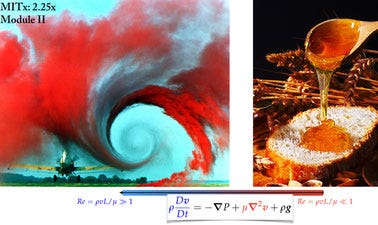
🌀 Advanced Fluid Mechanics 2: The Navier-Stokes Equations for Viscous Flows
Learn to apply the Navier-Stokes equations to viscous-dominated flows; including pipe flows, channel flows and free surface flows, use dynamical similarity and dimensional analysis, Stokes flows, similarity solutions and transient responses, lubrication analysis and surface tension.
The Helmholtz-Hodge decomposition split vectors fields in two orthogonal subspaces: incompressible and irrotational. In 2-D, corresponds to the sum of a gradient field and a rotated gradient field.
💻 CFD Whitepaper - Automated Multi-Material Simulation in the Cloud
With StrömungsRaum®, you optimize the development of extrusion tools through cloud-based simulations. Errors are detected early, development times shortened, and production costs reduced. Thanks to high-performance computing, intuitive operation, and top-tier data security, you sustainably enhance the quality and efficiency in extrusion.
This book is a guide to numerical methods for solving fluid dynamics problems. It describes in detail the most widely used discretization and solution methods, which are also found in most commercial CFD programs. It also covers some advanced topics, like moving grids, simulation of turbulence, computation of free-surface flows, multigrid methods, and parallel computing. Since CFD is a very broad field, we provide fundamental methods and ideas, with some illustrative examples, upon which more advanced techniques are built.